Don't Walk Past It: How Your Staircase Could Be the Boldest Design Statement in Your Home
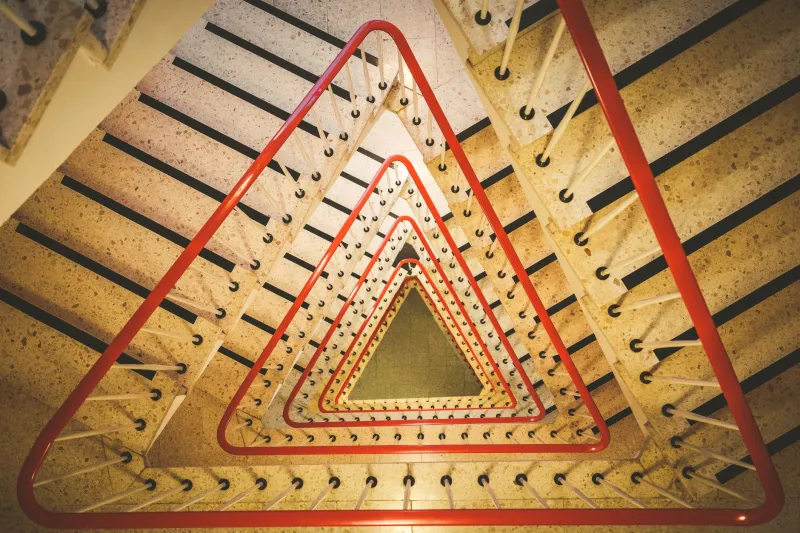
There's a funny thing that happens when people plan a home redecoration. They'll spend weeks choosing the perfect shade for the sitting room, agonise over wallpaper samples in the bedroom, maybe even splash out on a statement ceiling. Then they walk straight past the staircase like it doesn't exist.
It does exist. And it's probably one of the most visible structures in your entire house.
In most Northern Irish homes — terraces, semis, new builds alike — the staircase is the first vertical journey your eye takes when you step through the front door. It leads from your hallway upward, connecting every floor of your home, and it gets used dozens of times a day. So why do we treat it like a blank corridor we just have to get through?
Time to change that.
The Stairwell as a Design Zone
Before you reach for the magnolia, it's worth thinking about the staircase as its own distinct design zone rather than just an extension of the hallway. It has unique characteristics — height, narrow width, the rhythm of the risers, a long unbroken wall running alongside it — that actually give you some brilliant options other rooms simply don't.
That tall wall running up alongside the stairs? In interior design terms, that's prime real estate. It's often the largest uninterrupted wall surface in the whole house, and because it's angled and elevated, it draws the eye naturally. Whatever you put there, people are going to notice it.
The risers — the vertical faces of each step — are another opportunity that most homeowners leave completely blank. And the landing at the top of the stairs is often treated as a forgotten in-between space, when it could easily be a proper design moment in its own right.
What Paint Can Do on a Staircase
Let's start with paint, because it's the most accessible option and can deliver remarkable results without requiring a major investment.
Painted risers are probably the most talked-about staircase trend of the last few years, and for good reason — they work. Painting each riser in a contrasting colour to the tread (or alternating between two or three tones) adds rhythm, personality, and a touch of playfulness. It works especially well in family homes where you want to inject some character without going full maximalist.
If you want something more subtle, try painting just the risers in a single deeper tone — a navy, a forest green, a warm terracotta — while keeping the treads natural wood or a neutral. The effect is graphic without being overwhelming, and it reads really well from the bottom of the stairs looking up.
For the stairwell walls themselves, don't be afraid to go darker than you would in other rooms. Because stairwells are transitional spaces rather than rooms you sit in for long periods, they can carry a much deeper, moodier colour without feeling oppressive. A rich teal, a slate blue, or even a deep charcoal can look genuinely stunning when combined with good lighting on the stairs.
One practical note for Northern Irish homes specifically: staircases, particularly in older properties, can be subject to draughts and temperature fluctuations. Make sure you're using a paint with good durability and some flexibility — a quality mid-sheen or satin finish tends to hold up better than flat matt on high-contact surfaces like risers and handrails.
Wallpaper on the Stairwell Wall
If you're confident with wallpaper, the stairwell wall is one of the most rewarding projects you can take on — though it does require a bit of patience and the right preparation.
The key consideration is choosing a design that works at height and at an angle. Large-scale botanical prints, maximalist patterns, and bold geometrics all look spectacular on a tall stairwell wall because you get to see the full repeat of the pattern playing out across the whole surface. It's the kind of effect that genuinely stops visitors in their tracks.
For a more cohesive look, consider continuing the same wallpaper from the hallway up the stairwell. This creates a sense of flow and makes the whole ground-to-upper-floor journey feel intentional rather than cobbled together. If your hallway already has a feature wall, picking up that paper on the stairwell is an elegant way to tie the spaces together.
Because stairwells in Northern Ireland tend to be narrow and can have condensation issues — especially in older houses where insulation isn't brilliant — it's worth choosing a wallpaper with a degree of moisture resistance, or at least one that's been properly hung on well-prepared, sealed walls. Vinyl-coated or washable wallpapers are a sensible choice here, particularly on the lower sections of the wall that might catch the odd bump from bags or coat sleeves.
The Landing: Don't Forget the Top of the Stairs
The landing is where a lot of staircase design schemes fall apart, simply because people run out of steam (or budget) by the time they get up there. But the landing is worth treating as its own small moment.
A feature wall at the top of the stairs — facing you as you come up — is one of the most effective accent wall positions in the whole house. Because it's the natural focal point at the end of the staircase journey, whatever you put there commands attention. A single bold wallpaper panel, a deep paint colour, or even a painted arch shape can make the landing feel finished and considered rather than like a forgotten in-between space.
If your landing has a window, think about how natural light will interact with whatever you choose. North-facing windows in Ulster (and there are plenty of those) tend to cast a cooler, greyer light, which can make some colours look quite different to how they appeared on the sample card. Warmer tones — ochres, terracottas, warm whites — tend to compensate well in low-light conditions.
Practical Bits Worth Knowing
A few things to bear in mind before you start:
- Access matters. Painting or papering a stairwell requires working at height, often on a ladder positioned on the stairs themselves. If you're not confident doing this safely, it's worth getting a decorator in. The results are worth the spend.
- Wear and tear is real. Staircases take a battering — shoes, bags, children, pets. Choose paints specifically designed for high-traffic areas on the risers and lower wall sections, and opt for wipeable finishes wherever possible.
- Test your colours in situ. The light in a stairwell shifts dramatically depending on the time of day and the season. Paint a decent-sized test patch and live with it for a few days before committing.
- Don't neglect the woodwork. Freshly painted or papered stairwell walls will immediately expose tired, chipped skirting boards, handrails, and spindles. Budget a bit of time and paint to freshen these up at the same time — it makes a huge difference to the finished result.
Worth Every Step
The staircase is one of those features that, once you start looking at it properly, you wonder how you ever ignored it. It's tall, it's prominent, it connects every part of your home, and it sees more footfall than almost any other space. Give it the attention it deserves and it'll repay you every single time you walk through your front door.
And honestly? After all those years of magnolia, your stairs have earned something better.