Ditch the Magnolia: How Moisture-Resistant Wallpaper Is Revolutionising Ulster Bathrooms
Let's be honest. For years, the bathroom was the room everyone forgot about when it came to proper decorating. A tin of white or magnolia vinyl silk, a roller, an afternoon — job done. And then six months later you'd notice the paint bubbling around the shower, a suspicious dark patch creeping up behind the toilet, and that general air of a room that's given up on itself.
In a climate like Northern Ireland's, where the air outside is rarely what you'd call dry and the air inside a bathroom after a hot shower is basically a rainforest, paint has always had a tough time of it. But here's the thing: wallpaper — the right wallpaper, applied the right way — can actually outperform paint in a bathroom setting. Not just aesthetically, but practically.
This isn't a gimmick. It's a genuine shift in what's available on the market, and Ulster homeowners are starting to catch on.
Why Paint Keeps Letting Your Bathroom Down
Even the best moisture-resistant paints have their limits. Bathrooms cycle through dramatic swings in temperature and humidity every single day. Steam condenses on cold walls, water splashes onto surfaces near the bath or shower, and ventilation — especially in older terraced houses and bungalows across the province — is often inadequate.
Vinyl silk paints are marketed as washable and moisture-tolerant, but they're still a film sitting on top of a porous surface. Once that film cracks, lifts, or gets breached around fittings, water finds its way in. Mould follows. Repainting is a temporary fix at best.
The deeper issue is that paint doesn't add any structural protection to your walls. It sits on top. Wallpaper, particularly the newer generation of bathroom-specific products, creates a much more robust barrier — and it does it while looking genuinely stunning.
What's Actually Available Now (And It's Impressive)
The wallpaper industry has invested seriously in developing products that can handle wet environments. Here's what to look for when you're shopping:
Vinyl-coated wallpapers are the most widely used option for bathrooms. The paper substrate is laminated with a PVC or acrylic coating that repels moisture, resists steam, and can be wiped down without damage. These aren't the thick, shiny vinyl of your granny's kitchen — modern versions have texture, depth, and genuinely beautiful finishes.
Non-woven (fleece-backed) wallpapers are another excellent choice. The non-woven backing doesn't absorb moisture the way traditional paper does, which means it's far less likely to bubble, shrink, or develop mould behind the face. Many decorators working across Belfast and beyond now default to non-woven in any room where humidity is a concern.
Solid vinyl wallpapers — sometimes called commercial vinyl — are the heavy-duty end of the spectrum. Originally developed for hotels and healthcare settings, they're increasingly available for residential use. They're practically indestructible, completely washable, and come in a range of patterns and textures that look far more refined than their industrial origins might suggest.
Some manufacturers have also developed specific bathroom collections with antimicrobial treatments built into the coating — an extra layer of protection that actively resists mould growth rather than just tolerating humidity.
Getting the Installation Right
The wallpaper itself is only half the story. In a bathroom, the installation has to be done properly or you'll be back to square one within a year.
Preparation is everything. Walls need to be clean, dry, and properly primed before a single strip goes up. Any existing mould must be treated — not just painted over — with a specialist mould killer. Skipping this step is the most common mistake, and it's a costly one.
Use the right adhesive. Standard wallpaper paste isn't designed for high-humidity environments. You need a fungicide-resistant adhesive, and in a bathroom it's worth spending a bit more on a heavy-duty option designed for vinyl wallpapers. Follow the manufacturer's guidance on soaking times too — non-woven papers typically go up paste-the-wall rather than paste-the-paper, which actually makes them easier to hang.
Seal the seams and edges. Where wallpaper meets a bath panel, shower tray, or basin, use a clear waterproof sealant along the bottom edge. This is the vulnerable point where water can track behind the paper if it's left open. A neat bead of silicone along those joins takes ten minutes and adds years to the life of the installation.
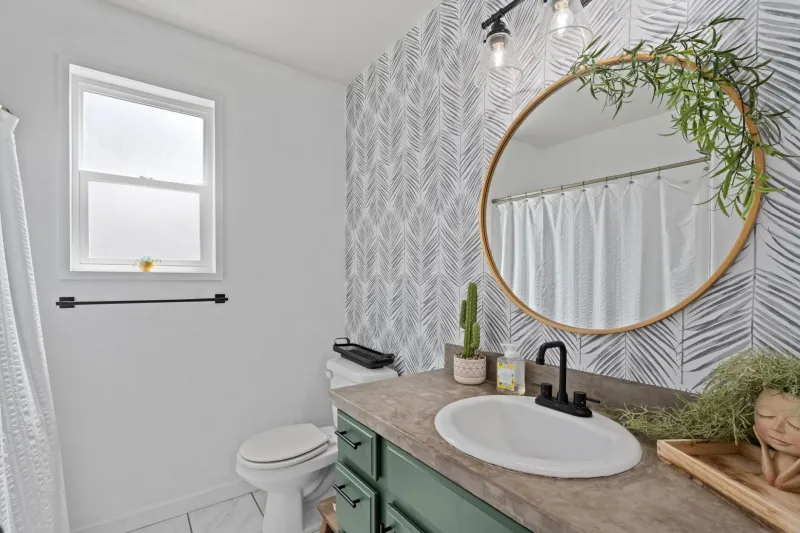
Think about placement. You don't have to wallpaper every wall in the bathroom. In fact, a popular approach right now is to wallpaper the walls that aren't directly adjacent to the shower or bath — the wall behind the toilet, the wall facing you as you walk in — and tile or use a moisture-resistant panel system in the wet zone itself. You get the visual drama of wallpaper without putting it in the most challenging spot.
Real Rooms, Real Results
The transformation wallpaper can bring to a bathroom is hard to overstate if you've only ever lived with painted walls in there.
Imagine a standard Victorian terrace bathroom in south Belfast — small, north-facing, the kind that never quite feels warm. Painted in a pale grey that looked fine in the tin but reads as flat and cold on the walls. Swap those three non-wet walls for a deep botanical print in dark greens and warm ochres on a non-woven vinyl substrate, and the room feels completely different. Warmer, more considered, more like somewhere you'd actually want to spend time.
Or picture a new-build en suite — those rooms that developers finish in the most inoffensive white imaginable and leave you to deal with. A geometric tile-effect vinyl wallpaper on the back wall behind the basin adds pattern and visual structure without any of the mess or cost of actual tiling. It photographs beautifully, it cleans easily, and it cost a fraction of what retiling would have.
These aren't fantasy renovations. They're achievable on realistic budgets with products that are readily available.
Colour and Pattern: What Works in a Bathroom
One of the great freedoms of using wallpaper in a bathroom is that you can go bolder than you might dare elsewhere. The smaller scale of most bathrooms actually works in favour of dramatic patterns — a large-scale tropical leaf print that might feel overwhelming in a living room can feel perfectly balanced in a compact bathroom.
Deep, moody colours — navy, forest green, charcoal, inky blue — work exceptionally well in bathrooms because the contrast with white sanitaryware and chrome fittings is so sharp. Don't be afraid of going dark. In a room where the lighting is often warm and focused, a deep-toned wallpaper creates an atmosphere that painted walls simply can't match.
If you're nervous about committing to something bold, start with one wall. The wall directly opposite the door is the natural focal point and the safest place to experiment.
A Note on Ventilation
No wallpaper, however moisture-resistant, will perform well in a bathroom that has serious ventilation problems. If your extractor fan is underpowered, broken, or simply not used, you're fighting a losing battle. Before you invest in beautiful wallpaper, make sure the basics are in order — a decent extractor fan running during and for at least fifteen minutes after every shower makes a significant difference to how long any wall finish lasts.
Time to Rethink the Bathroom
The idea that bathrooms are too difficult, too damp, or too risky for wallpaper is outdated. Modern products have addressed the technical challenges, and the aesthetic rewards are substantial. If your bathroom is currently limping along in magnolia or a tired grey vinyl silk, it might be time to consider what a properly specified, properly installed wallpaper could do for it.
Your bathroom deserves more than a tin of paint and an apology.