The Door That Changes Everything: Why Your Interior Doors Deserve a Proper Paint Job
Walls get all the attention. Ceilings are having their moment. But interior doors — those flat, largely ignored panels you walk through fifty times a day — might be the single most overlooked design opportunity in your home. Here's why a bold door could be the move that ties your whole home together.
The accent door trend has been building quietly for a couple of years now, gaining traction on design accounts and home renovation blogs before filtering into mainstream decorating conversations. The idea is straightforward: instead of painting your interior doors the same white or cream as your woodwork and forgetting about them, you treat them as deliberate design elements — using colour, finish, or even wallpaper to make them work harder for the overall look of your home.
In practice, it's one of the most cost-effective decorating upgrades you can make. A litre of paint and a half-day's work can genuinely transform how a room feels.
Why Doors? Why Now?
There's a practical reason this trend has landed well in Ulster homes specifically. Many Northern Irish properties — Victorian and Edwardian terraces, inter-war semis, and even a lot of the bungalows built through the sixties and seventies — have original or replacement panel doors that have real visual weight. These aren't hollow modern slabs; they have depth, geometry, and character. Give them a colour and they become a feature.
At the same time, homeowners who've already tackled their walls are looking for the next move. Feature walls are established territory. Statement ceilings are increasingly mainstream. Doors are the logical next frontier — and they're a lower-commitment, lower-cost experiment than either of those options.
The Anchor Point Theory
The most compelling argument for accent doors isn't just that they look good in isolation — it's what they do for the rest of the space around them.
Think about how you move through your home. You stand in one room and you see a door into the next. That door is a visual full stop, a frame, a threshold. When it's painted in a considered colour, it creates a relationship between the two spaces. It anchors the design narrative of the whole house in a way that a single feature wall rarely does.
A deep forest green door at the end of a neutral hallway, for example, creates anticipation. It pulls your eye forward. It makes the journey through the house feel intentional rather than accidental. A dusty rose door between a living room and a kitchen can bridge two different colour schemes in a way that feels cohesive rather than chaotic.
This is the difference between decorating a series of individual rooms and decorating a home.
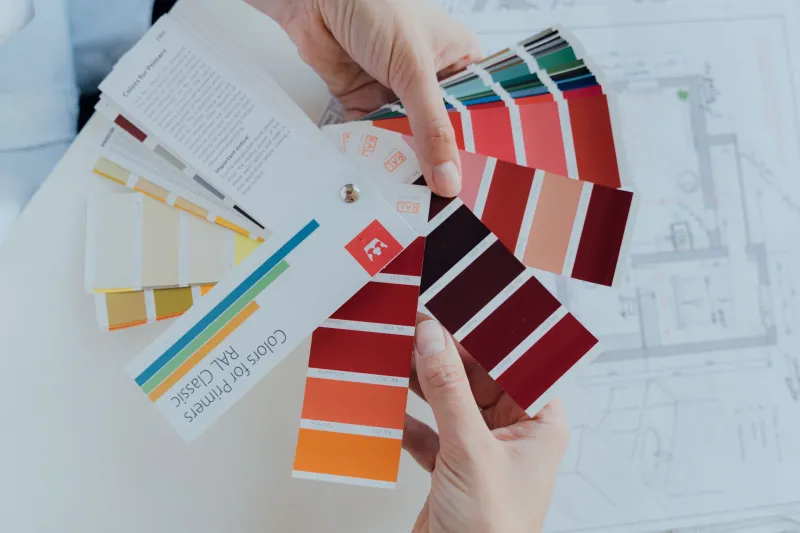
Choosing Your Colour: A Few Rules Worth Knowing
There's no single right answer here, but there are some approaches that tend to work better than others.
Pull from the room's existing palette. The most reliable approach is to identify a colour that already exists in the room — in a rug, a cushion, artwork, upholstery — and amplify it on the door. This creates a deliberate echo rather than a random addition. It makes the door feel like part of the plan.
Go darker than you think. Doors painted in mid-tones often look a bit lost. The colours that tend to work best are either very dark (navy, forest green, charcoal, deep burgundy) or quite specific and unusual (a dusty terracotta, a muted sage, a soft slate blue). The safe middle ground tends to disappear.
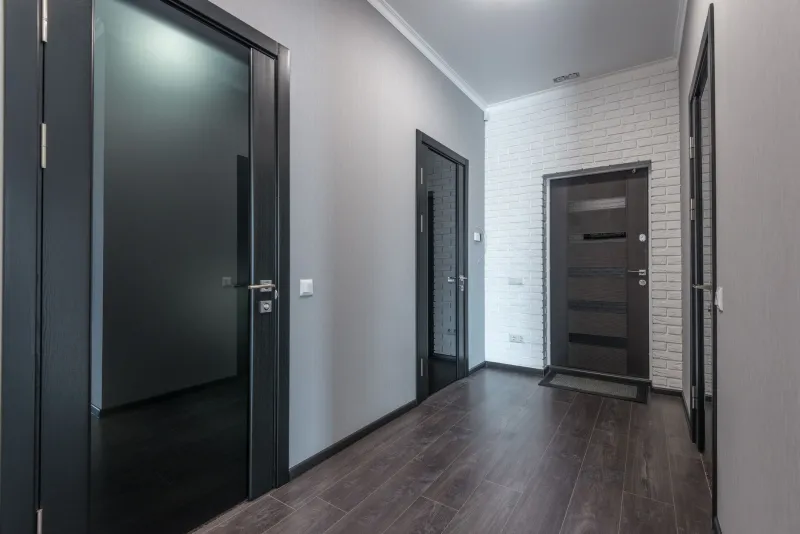
Consider the adjacent spaces. If your door connects two rooms with very different colour schemes, a neutral-but-not-boring option — a warm dark grey, an aged bronze tone, or even a deep off-black — can work as a bridge. If your rooms share a colour family, you can afford to be more specific and more bold.
Don't forget the door frame. Painting the door and leaving the frame in white or cream is one approach. Painting both door and frame in the same colour is another, and it creates a more architectural, deliberate effect — almost like a portal. Neither is wrong, but they read differently.
Getting the Finish Right in Ulster Homes
This is where a lot of DIY door painting goes sideways. Interior doors take a beating — handles are grabbed, surfaces are knocked, kids lean on them, pets scratch them. You need a finish that can cope.
For most interior doors, satin or semi-gloss is the sensible choice. It's durable, wipeable, and has enough sheen to look considered without being as unforgiving as full gloss (which shows every imperfection in the surface). Flat or matt finishes on doors tend to mark and scuff quickly, which is frustrating when you've gone to the effort of making the door a feature.
If your door is in rougher shape — old paint layers, minor dents, grain raising — spend time on preparation. A good sand, a coat of primer, and a light fill on any significant dents will make the finished result look genuinely professional rather than DIY. Rushing the prep is the most common reason a painted door disappoints.
For high-traffic doors — the one into the kitchen, the bathroom door, anything the kids use constantly — consider a water-based satinwood or an eggshell with a hardener additive if your chosen brand offers one. It's a small upgrade that makes a real difference to longevity.
What About Wallpapered Doors?
This is a more niche approach, but worth mentioning because it can look genuinely spectacular when it's done well. A panel door with the recessed panels filled with wallpaper — while the raised mouldings are painted in a complementary colour — creates something that's closer to a piece of furniture than a door. It's particularly effective in hallways and on doors that are visible from the main living areas.
The practical considerations are real: you need a paper that can handle occasional contact without marking, and the application requires patience and precision. But as a one-off statement in the right property, it's hard to beat.
Start Small, See What Happens
If you're unconvinced, start with a single door — ideally one that's a bit tucked away, like a downstairs loo or a utility room door. Pick a colour that's a step or two bolder than you'd normally consider. See how it feels after a week.
Chances are you'll be back for more paint before long. Doors are one of those things where once you notice the potential, you can't stop seeing it everywhere you look.